 UKROA • DMVP CHAPTER← Back to Home
Identity • Heritage • Living Tradition
Kirat Culture
Who are the Kirati and Rai people? A welcoming guide for Kirati families, especially young people growing up in the United States.
Kirati communities are very diverse. Names, traditions, clothing, rituals, languages, and origin stories may differ from one community or village to another. This guide presents shared themes while honoring those differences.
The simplest explanation+
Kirati is a broad cultural and historical identity connected mainly with Indigenous peoples of eastern Nepal and nearby Himalayan regions. Rai people are one important part of the wider Kirati family.
A helpful comparison is: Kirati is like a large family tree. Rai is one major branch, and that branch contains many smaller communities with their own languages and traditions.
Other peoples commonly associated with the wider Kirati identity include Limbu or Yakthung, Yakkha, and Sunuwar or Koĩts. People may describe their identities differently, so it is respectful to use the name each community uses for itself.
Where are Kirati people from?+
The ancestral homeland of many Kirati communities lies in the hills and mountains of eastern Nepal, especially around river valleys and regions east of the Kathmandu Valley. Kiranti languages are also spoken in neighboring parts of Sikkim and the Darjeeling region of India.
Today, Kirati and Rai families live throughout Nepal and around the world, including the United States, United Kingdom, Hong Kong, India, Bhutan, Australia, and other countries.
Living outside Nepal does not make someone less Kirati. Culture travels through family stories, language, food, music and dance, ceremonies, respect for elders and ancestors, community gatherings, and knowledge of one’s family and ancestral village.
Who are the Rai?+
Rai does not describe one completely uniform community with one language and one exact set of customs. It is a shared identity that includes many distinct peoples.
Rai communities include Bantawa, Chamling, Kulung, Khaling, Thulung, Dumi, Puma, Nachhiring, Mewahang, Lohorung, Yamphu, Wambule, Jero, and others. Lists vary because identity and language classifications are complex.
Some of these languages are so different that speakers cannot automatically understand one another. Academic linguists therefore describe Rai as a very diverse ethnic grouping rather than one single language.
A child can truthfully say: “I am Kirati. I am Rai. My family may also belong to a more specific Rai community, language group, clan, or ancestral place.”
Kirati languages+
Most traditional Kiranti languages belong to the Sino-Tibetan, also called Trans-Himalayan, language family. There is no single language called “the Rai language.” Rai families may speak Bantawa, Chamling, Kulung, Khaling, Thulung, Puma, Dumi, or another ancestral language. Many also speak Nepali, English, Hindi, or other languages.
Several Kiranti languages are endangered because fewer children are learning them at home. Even learning a few greetings, names for relatives, numbers, foods, songs, prayers, blessings, or the names of a family’s clan and ancestral village can keep a connection alive.
A child does not need to speak perfectly to belong. Learning slowly is still a meaningful way to preserve a connection.
Mundhum: knowledge passed through generations+
A central part of many Kirati traditions is commonly called Mundhum, although pronunciation, content, and terminology vary among communities.
Mundhum is more than a single book. It is traditionally a body of oral knowledge carried through recitation, ritual, songs, stories, genealogies, memories, moral teaching, and explanations about people’s relationship with nature and ancestors.
A child-friendly explanation is: “Mundhum is like a living library carried in people’s memories, voices, ceremonies, and stories.” Traditional ritual specialists may preserve long recitations and guide ceremonies; their names and roles vary among communities.
Religion and worldview+
Many Kirati traditions emphasize close relationships among human beings, ancestors, the household, land and water, plants and animals, seasonal cycles, spiritual forces, and community responsibilities.
This worldview is often called Kirat Mundhum or the Kirat religion. Scholars commonly describe it as involving ancestral traditions, nature-centered practices, and ritual specialists. Mundhum helps guide rituals and everyday cultural life.
Not every Kirati person practices religion in the same way. People may identify with Kirat Mundhum, Hinduism, Buddhism, Christianity, more than one tradition, or no religion. It is therefore better to say that many Kirati people follow Mundhum traditions than to assume everyone follows exactly the same religion.
Sakela, Ubhauli, and Udhauli+
One of the best-known Rai-Kirati celebrations is Sakela, also called by related names in different places. Sakela is connected with community, agriculture, seasonal change, ancestors, and respect for nature. Celebrations commonly include group dancing and music.
Ubhauli is associated with upward seasonal movement, planting time, and the warmer part of the agricultural cycle. Udhauli is associated with downward seasonal movement, harvesting, and the colder part of the cycle. Exact explanations and practices differ among communities.
Sakela Sili+
The dance performed during Sakela is often called Sakela Sili. Dancers may form a circle or line and move together.
Movements can represent planting and harvesting, hunting or fishing, birds and animals, weaving, combing hair, community work, courtship, journeys, and ancestral stories. The dance is therefore not simply entertainment—it can function as a moving storybook.
Dhol and jhyamta+
Dhol is a double-headed drum played with rhythmic beats. Jhyamta, also called ghyamta, are metal cymbals struck together.
Their sound guides dancers and gives Sakela gatherings their recognizable energy.
Home, hearth, and ancestors+
For many Rai communities, the home is also a sacred cultural space. One important tradition is associated with the Suptulung, a household hearth or sacred fireplace. Its meaning and form vary, but it may represent ancestry, family continuity, household spirituality, and connection to the land.
The hearth is not only where a family cooks. It can also remind the family who they are, where they came from, and how generations remain connected.
Family, clan, and ancestral place+
Kirati and Rai identity is often connected to more than a last name. Families may identify through a particular Rai community, clan or lineage, ancestral village, river valley or homeland, language, oral genealogy, and ritual traditions.
Two people whose last name is Rai may come from different language communities and have different customs. Asking politely about someone’s specific community is better than assuming all Rai people are identical.
Food and daily life+
Traditional Rai food varies by altitude, region, farming patterns, and family custom. Common ingredients may include rice, millet, corn, buckwheat, leafy greens, beans and lentils, fermented foods, meat in families that eat it, and local herbs and spices.
Food is an important way diaspora children can connect with grandparents and family history. A recipe can carry information about climate, farming, celebration, and migration.
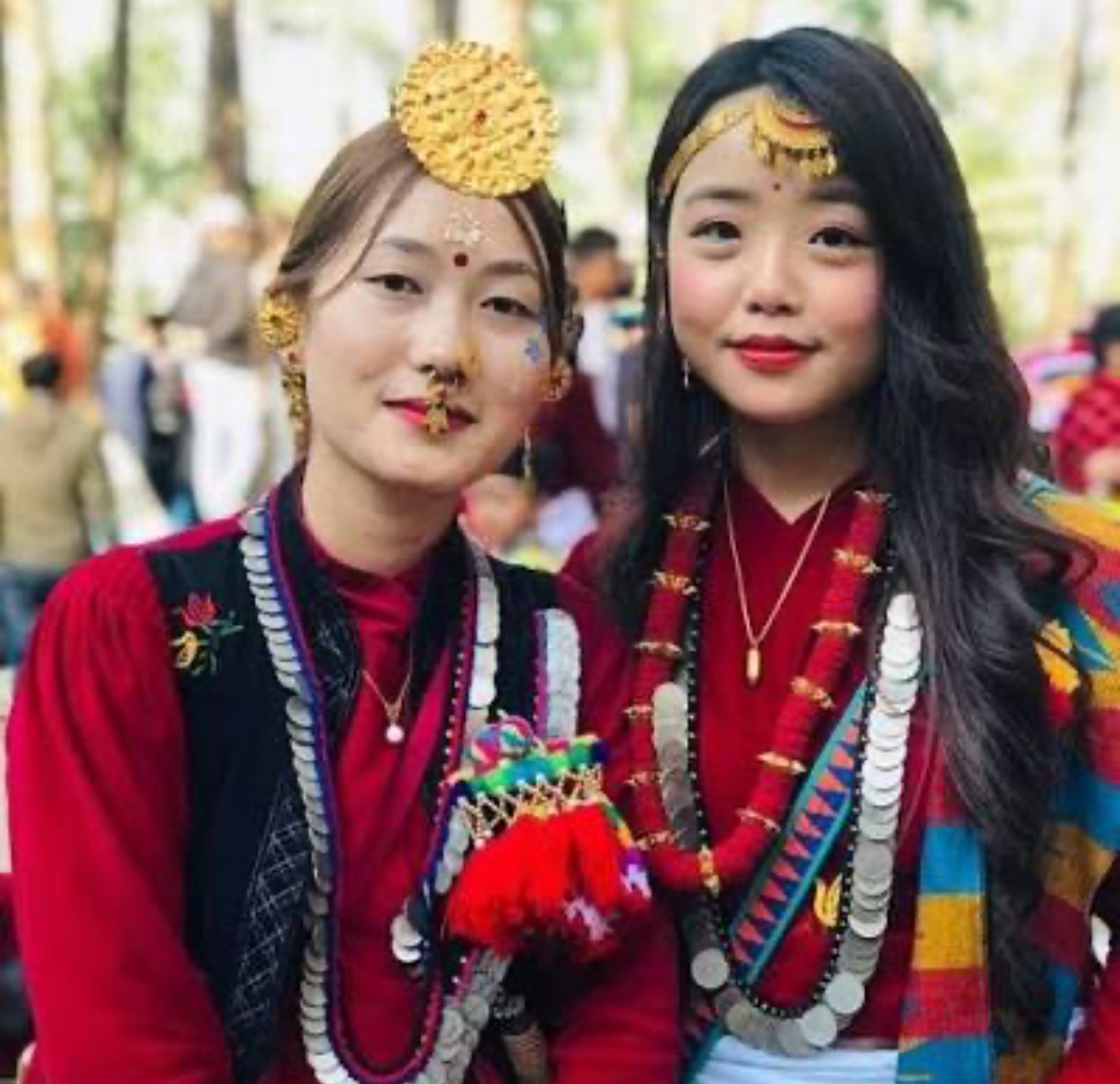
Clothing and jewelry+
There is no single outfit worn by every Rai community. Traditional clothing differs by region, gender, occasion, and subgroup.
At cultural programs, people may wear woven fabrics, traditional caps, shawls, blouses, wrap-style garments, belts, necklaces, earrings, coins, or other ornaments. Traditional clothing is meaningful, but culture is not only a costume. A person remains Kirati while wearing jeans, school clothes, sports uniforms, or anything else.
Kirati history+
Nepalese chronicles and later historical traditions describe a Kirat period or Kirat rulers before the Licchavi period. Kirati communities also preserve histories and ancestral narratives through Mundhum.
The very ancient period is difficult to reconstruct precisely. Written records and archaeological evidence are limited, and historians debate dates, rulers, and the relationship between ancient people called Kirata in old texts and present-day Kirati communities.
A careful explanation is: Kirati people have deep historical roots in the Himalayan region and an important place in Nepal’s history. Some details of the earliest period come from chronicles and oral traditions and remain debated by historians.
Contribution to Nepal and the wider world+
Kirati and Rai people have contributed through farming and environmental knowledge, language and oral literature, music and dance, military service, education, sports, public service, art, film and music, migrant and diaspora communities, and Indigenous-rights and language-preservation movements.
Their cultural contribution is not only in the past. Kirati culture is living and continues to change.